Shuttering the Red Market: The Dark Truth Behind Organ Sales


My inbox was flush with the usual late afternoon mail, email, and phone messages. Some had a file attached, others had a Post-it note. Most were straightforward, but one stood out — a note scrawled in bold red Sharpie and labeled “SPECIAL.”
Curiosity piqued, I peeled it off and read the transcript: “I want to pay people to donate kidneys. This will be my legacy. How do I make it happen?” The caller was a well-meaning entrepreneur, convinced that applying business smarts to end-stage renal disease (ESRD) would solve everything.
“It’s simple,” he said when I called. “Just treat it like any market.” He was sincere, and I hated to burst his bubble. But sincerity deserves honesty — and maybe a few alternatives. I took a deep breath.
“Where do you want to start? With the unethical part, the illegal part, or the better idea part,” I asked.
His motivation was personal and pure, so I gently steered him through the minefield of what is often called the “red market,” where organs are illegally harvested, traded, and transplanted. His philanthropic spirit took it well. When the call ended, he was happily connected to a busy transplant program for a more conventional gift.
In most — but not all — of the world, it’s illegal to pay for a human organ. The National Organ Transplant Act (NOTA) of 1984 bans the buying and selling of human organs in the United States. Most other nations have similar laws. Commodifying organs risks exploitation, where the wealthy “farm” the poor like they are spare parts in a dystopian warehouse. It dehumanizes everyone involved, often benefiting the rich, while preying on the desperate.
Legal transplants save lives every day. Organs come from one of two sources. Living donors are healthy people, such as a family member, who donate a spare organ, like a kidney or part of their liver, while still alive and healthy.
Cadaveric donors are people who have died (usually from an accident or illness) and whose healthy organs are donated after death to help save someone else’s life. This often happens when the person is declared “brain-dead,” meaning their brain has completely stopped working and can’t recover, but machines keep their organs alive temporarily to keep the organs healthy for transplantation.
Kidney transplants are among the safest and most common transplants performed daily. They beat dialysis hands down for quality of life. Globally, about 65,000 legal cadaveric donor transplants are performed every year, and another 45,000 kidneys are lawfully transplanted from living-related donors.
Still, despite the proven track record of success for renal transplants, 100,000 Americans languish on waitlists annually, highlighting the supply-demand crunch for usable kidneys to treat these patients.
There are laws and strict protocols that must be followed throughout the process. Organs cannot be taken without permission, and in the case of potential cadaver donors, brain death must be determined.
Laws are broken, bent, or ignored.
A 2021 case involving a prominent U.S. hospital reads like a horror story, where a patient was hurriedly pronounced brain dead without appropriate documentation. The patient was indeed brain dead, but the protocol was not followed properly. This is frightening — what if a patient is not brain dead, yet their organs are harvested?
The reason for the strict protocols, which some might see as overly regimented and cumbersome, is to protect patients and preserve confidence in the organ donation system. This failure rekindled concerns that donor organ shortages prioritize donor organ supply over ethical safeguards. Critical review of the U.S. organ transplant system and its oversight by the United Network for Organ Sharing (UNOS) remains at the forefront of health regulation and oversight today.
A successful organ transplant system must inspire confidence.
More familiar to most Americans are the urban and internet legends of organ harvesting. Most have heard some variant of the tale of the hapless tourist awakening in pain, lying in a blood-soaked ice-filled tub, with a flank incision and a warning to get their kidneys checked because “we took them!” This is a common urban legend that resurfaces often. While no case of a “bathtub kidney heist” has been documented, the tale is not far afield from the possible.
Organ farming is a common plot line for a science fiction horror tale. It is also real.
In the 1977 novel “Coma,” author Robin Cook’s protagonist, a medical student named Susan Wheeler, describes a facility housing comatose patients as “a warehouse for spare parts. They’re keeping those patients alive only for their organs.”
China has been accused of hosting organ farms, where organs are forcibly harvested from prisoners and oppressed groups. These victims are treated as if they are nothing more than livestock; their value is tied to their organs.
Just days ago, China’s President Xi Jinping and Russia’s Vladimir Putin were overheard discussing the utility of organ transplants to prolong life, noting their scientists felt a person could live 150 years or more by using transplanted organs. Given China’s track record with forcible organ harvesting from dissidents and prisoners, this is a disturbing revelation.
China and Russia are not alone. Pakistan, India, and the Philippines are known for “transplant tourism,” where poor locals sell kidneys to foreign buyers. Here, the buyers may feel they are compensating the donors well when they pay many thousands for an organ, yet typical donors only see a fraction of what was promised. Middlemen — organ brokers — pocket the lion’s share of the sizeable fees.
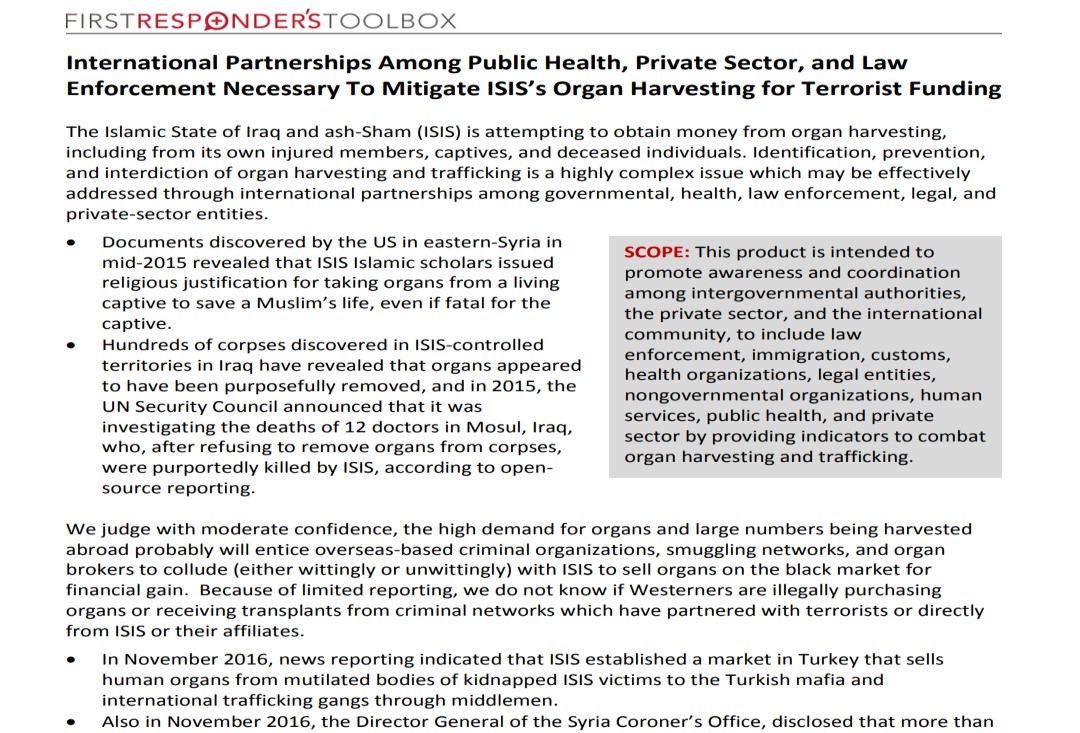
Terrorists engage in organ trafficking as well. In 2017, a U.S. Joint Counterterrorism Taskforce publication noted that ISIS issued a “religious justification for taking organs from a living captive to save a Muslim’s life, even if fatal for the captive” and referenced reports of hundreds of corpses where organs “appeared to have been purposefully removed.”
‘Kidneys grow back, don’t they? And how many do I have? Three, right?’
Organ trafficking in the West often relies on sophisticated organ trafficking networks, where public officials, doctors, and established hospitals may be involved. In 2017, the prominent head of a reputable nephrology clinic in the Costa Rican city of San Jose was convicted of leading an illegal organ trafficking ring.
In this scheme, impoverished Costa Ricans were recruited with the promise of a substantial payday. The donors’ concerns were soothed by the lie that their kidneys would grow back (they do not) or that the donor had extra kidneys (again, a lie). The hapless donors were assured they had nothing to lose.
Costa Rica already had a thriving medical tourism industry, but the doctors and hospitals discovered they could enrich themselves far more by performing illegal operations on foreign patients. Provided with the “proper paperwork” and an assurance that the organ is willingly donated is enough for some to convince themselves that their actions are not part of a brutal criminal act.
An organ trafficking network requires a reliable supply of donors. At the same time, hospitals provide a safe environment with a patina of legitimacy for those recipients willing to pay the high fee to “jump the line” for an organ. The surgeons, nurses, laboratories, administrators, and even public officials, such as the police, prosecutors, and judges, are driven by greed. Orchestrating these schemes across the globe are groups commonly associated with crime: Chinese Triads, Mexican drug cartels, Russian Mafia, and other highly organized criminal organizations.
Human trafficking for organ removal is not the same as organ trafficking.
Organ trafficking describes the illegal trade or procurement of organs for transplant. These organs may be obtained through the red market from a living, though not necessarily a related donor, or from a brain-dead, cadaver donor without family consent.
The focus of organ trafficking is the organ itself. Persons exploited as part of an organ trafficking scheme are usually desperate but are described as “willing participants” in the scheme. They may even be coached to claim they are a relative of the person receiving the organ in an attempt to “legitimize” the transplant if questioned by authorities.
In contrast, victims trafficked for organ removal are identified, recruited, transported, and forced to undergo organ harvesting. In a 2020 report, the United Nations Office on Drugs and Crime (UNODC) referenced potential Mexican drug cartel-operated organ harvesting operations that harvest kidneys from victims as part of debt service for their transport to the United States.
The clandestine nature of drug cartels and their gruesome practice of butchering victims make it difficult to determine if organ removal is purposeful or simply a consequence of their brutality. Without hard evidence from hospitals, physicians, and law enforcement, measuring the scope or veracity of these claims will remain difficult.
Harvesting an organ requires surgical skill and a proper support structure, such as an operating room for the organ harvest and proper equipment and supplies for preserving and transporting the organ. This is particularly true if the donor is to survive; the gruesome reality is that some may not care that the donor survives.
Transplanting the organ into the recipient is more complex and requires a team of surgeons, nurses, and support staff operating in a modern medical facility. These are more commonly seen in larger cities where legal transplants are also performed.
This is big business for the bad guys.
A kidney might sell for $150,000 or more on the red market. If the buyer has specific requirements, the cost will increase. In these “transplant-on-demand” systems, life imitates art. Like Robin Cook’s “Coma,” a buyer may commission a broker to obtain an organ from a person with specific characteristics. A 2017 report from Global Financial Integrity estimates that the illicit trade of human organs generates almost $2 billion annually.
A “bespoke” organ may come from a non-smoking, non-drinking, disease-free donor with a specific blood type, for example, increasing the chances of a transplant match and survival of the organ and, vitally, the recipient host.
For those victims who survive the organ harvest, the “compensation” may be the promise of a substantial cash payment or transport to the United States. Infections, death, or long-term disability are common for these victims. Clandestine clinics and hospitals may cater to the wealthy recipient, but the donors are expendable and unlikely to seek help.
Unseen does not mean uncommon.
The illegal organ trade thrives for several reasons. The continued unmet demand for kidneys stresses the legitimate renal transplant systems worldwide. As demand increases, the shadow economy of red market organ harvesting and trading grows in parallel. The World Health Organization estimated in 2018 that 10,000 illegal kidney transplants are done globally each year. It is difficult to assess what portion is from paid donors (organ trafficking) and what portion is from unwilling donors (human trafficking for organs).
In the Americas, there are numerous reports of victims of drug cartel violence who were supposedly victims of forced or coerced organ harvesting, but separating fact from fiction remains difficult. A conspiracy involving the necessary web of public officials, physicians, nurses, hospitals, clinics, as well as the brokers or cartel operatives and victims of harvesting seems difficult to keep secret.
The flimsy veil of legitimacy relies on each conspirator faithfully playing their part, and sadly, it seems enough in many instances. However, publicized cases of substantial trafficking operations in Asia, Africa, and Europe demonstrate that secrecy can be maintained for some time. Journalists, nongovernmental organizations, think tanks, and the U.N. all recognize that the organ trade is real, but none can truly quantify how pervasive it is.
Of course, drug cartels will have access to a steady supply of organs as long as people migrate across Latin America. It is unclear what the impact of the current efforts to close the southern border will have on the illegal organ trade. However, the cartels will embrace any opportunity to exploit any market they enter. They have proven their willingness to grasp every opportunity to profit, no matter the human cost.
Treating diseases is hard enough without the burden of allowing some of the very worst people to profit from the weak and the ill.
An ounce of prevention really is worth a pound of cure.
End-stage renal disease remains a serious problem, and renal transplantation is the optimal treatment. Matching supply with demand remains just out of reach. Often overlooked is the importance of preventing and controlling co-morbidities that can lead to kidney failure in the first place. Many cases of kidney failure are preventable, so it is possible to close the organ supply-demand gap.
Leading a healthy lifestyle to prevent and manage the two most common causes of ESRD, diabetes and hypertension, will significantly impact patient outcomes. Obesity causes insulin resistance and triples the risk of type 2 diabetes. Stress and diet are closely related to the development of hypertension.
The Make America Healthy Again initiative and our legacy will extend far beyond our borders, which have the potential to improve lives worldwide. Tomorrow’s Americans — and the world — are counting on us to make the right health decisions today, and in ways we might never imagine.
Dr. Jon Spiers is a heart surgeon, attorney, and political analyst focused on the intersection of health, law, and national security.